When a tree is hanging over your roof, dropping heavy limbs near a driveway, or leaning more than it used to, the estimate matters almost as much as the work itself. The best questions for tree estimates help you sort out who is truly qualified, what the job actually includes, and whether the price reflects safe, professional tree care instead of shortcuts.
A lot of property owners make the same mistake – they compare only the bottom-line number. That can lead to missed details, surprise charges, and work that creates bigger problems later. A tree estimate should give you clarity, not just a price.
Why the best questions for tree estimates matter
Tree work is not a simple handyman task. Removal, pruning, storm cleanup, stump grinding, and structural support all involve safety risks, equipment costs, and decisions that affect your property long after the crew leaves. Asking the right questions helps you understand whether a company is planning the job carefully or just trying to win it quickly.
This is especially important when the tree is close to a home, fence, power line, driveway, or neighboring property. In those cases, experience, planning, and compliance with recognized safety standards matter. A lower bid may leave out rigging, traffic control, cleanup, or the labor required to protect surrounding structures.
The goal is not to interrogate the contractor. It is to make sure both sides are clear on scope, safety, timing, and responsibility.
12 best questions for tree estimates
1. What exactly is included in this estimate?
This should be your starting point. A tree estimate can look straightforward while leaving out key services. Ask whether the quoted price includes debris removal, hauling, cleanup, log cutting, limb chipping, raking, and site protection.
If stump grinding is not included, that should be stated clearly. If hauling wood away costs extra, that should be stated too. A good estimate reduces assumptions.
2. Is this tree being removed, pruned, or reduced – and why?
Customers sometimes ask for one service when another is more appropriate. A reputable company should explain the recommended approach in plain terms. If a tree can be pruned safely instead of removed, you should hear that. If removal is necessary because of decay, structural failure, storm damage, or poor location, that should be explained as well.
This question helps you see whether the company is making a professional recommendation or simply agreeing to whatever was requested.
3. What factors are driving the price?
Not all tree jobs are priced the same way, even when the tree size looks similar. Access, crane needs, rigging difficulty, proximity to structures, condition of the tree, cleanup requirements, and emergency timing all affect cost.
This is one of the best questions for tree estimates because it gives context to price differences. One company may be charging more because the crew plans to lower limbs carefully over a roof. Another may be charging less because they are leaving out a major part of the job.
4. Are you licensed and insured for this work?
This is a basic question, but it is never a small one. Tree work involves serious liability. You want confirmation that the company is properly licensed to operate and carries appropriate insurance for the work being performed.
If a contractor becomes vague here, that is a red flag. Professional companies should be ready to address licensing and insurance clearly and confidently.
5. Do you follow ANSI standards and OSHA safety practices?
Homeowners may not use these terms every day, but they matter. ANSI standards relate to professional tree care practices, and OSHA regulations relate to worker safety. A company that takes both seriously is showing that it treats tree work as skilled, regulated work rather than casual labor.
This does not mean every estimate has to sound technical. It means the company should be able to explain its safety approach, crew procedures, and job planning in a way that builds trust.
6. Who will actually perform the work?
Sometimes the person giving the estimate is not the person managing the crew. That is not automatically a problem, but you should know whether the work is being handled by trained employees, subcontractors, or a mix of both.
Ask who will be on site, who supervises the job, and whether the crew has experience with this type of work. That matters even more for large removals, hazardous trees, or emergency storm cleanup.
7. How will you protect my home, driveway, lawn, and nearby structures?
A professional estimate should account for the full property, not just the tree itself. Tree work can affect roofs, fences, irrigation, siding, vehicles, retaining walls, and landscaping. If heavy equipment is coming onto the property, ask where it will be placed and how access will be managed.
No company can promise zero impact in every situation, because some jobs require equipment and some yards are tight. But they should be able to explain how they plan to minimize damage and work carefully around obstacles.
8. What happens if the scope changes once work begins?
This is a smart question because trees do not always reveal their full condition from the ground. Internal decay, hidden cracks, unstable root zones, or storm damage can change the job once cutting starts.
You want to know how extra work is handled. Will the company stop and review options with you? Will added charges be discussed before proceeding? Clear communication here helps avoid tension later.
9. Is cleanup and disposal included?
Many estimate disputes come down to cleanup. One customer assumes the yard will be left clean and all debris removed. The company assumes the customer is keeping the wood or handling some of the cleanup.
Ask whether branches, logs, sawdust, and chips will be removed. Ask whether the area will be blown off or raked. If you want firewood left behind, ask how it will be cut and stacked, if at all. Cleanup details should never be left to guesswork.
10. Do I need permits, utility coordination, or neighbor notification?
Some jobs are simple. Others involve city requirements, easements, protected trees, shared boundaries, or utility concerns. If the tree is near service lines, roadways, or property lines, it is worth asking whether any extra coordination is needed.
A reliable tree service should flag potential issues early. They may not handle every permit directly, depending on local rules, but they should let you know what needs attention before the work is scheduled.
11. What is the expected timeline?
Ask when the work can be scheduled and how long it should take. Timing matters for practical reasons, but also for safety. If the tree is storm-damaged or poses an immediate hazard, you need to know whether the company can respond quickly.
For non-emergency work, a reasonable wait is not always a bad sign. Good companies are often busy. What matters is getting a realistic schedule and clear communication if weather or workload affects it.
12. What payment terms and guarantees should I expect?
Before approving the estimate, ask how payment works and whether there is any workmanship guarantee related to the service provided. Tree care is not the same as buying a product, so guarantees have limits. For example, pruning results, stump grinding depth, and cabling outcomes may all have practical boundaries.
Still, the company should explain payment timing, deposit expectations if any, and what you can expect after the work is complete.
How to compare estimates without focusing only on price
If you receive multiple estimates, line them up and compare scope first. Look at what each company is actually doing, how they describe the work, and whether cleanup, disposal, stump service, and property protection are spelled out.
Then compare professionalism. Did the estimator inspect the tree carefully? Did they ask about your concerns? Did they explain the risks and options clearly? A low number with vague language is often less valuable than a fair price with a clear plan.
It also helps to consider responsiveness. In tree care, communication says a lot. If a company is hard to reach before the job, that usually does not improve once the work is scheduled.
Best questions for tree estimates in urgent situations
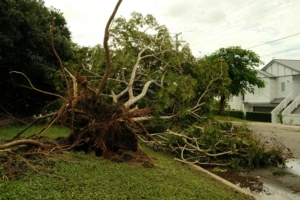
Emergency jobs change the conversation a bit. If a tree is down after a storm or a damaged limb is threatening a structure, speed matters. But even in urgent situations, you still need a few clear answers.
Ask whether the immediate goal is hazard mitigation only or full cleanup. Ask if the price covers temporary stabilization, complete removal, or both. Ask how quickly the crew can arrive and whether additional equipment may be required once they assess the scene in person.
In an emergency, nobody expects a long consultation. But you should still understand the scope, the safety approach, and the likely next step.
What a strong tree estimate usually feels like
A strong estimate feels specific, calm, and professional. It answers your practical questions without pressure. It gives you confidence that the crew knows how to manage risk, protect your property, and complete the work properly.
That is the standard local property owners should expect. Companies like M & R Tree Services build trust by combining experience, clear communication, and safe work practices that follow recognized industry standards.
If you are meeting with a tree company soon, keep these questions nearby and use them. The right estimate does more than tell you the cost. It helps you feel sure the job will be handled the right way from the start.