A tree can look stable for years, then fail after one windstorm, one saturated week of rain, or one more season of decline. That is why knowing when to remove a tree matters. Waiting too long can put your home, vehicles, power lines, and the people on your property at risk.
For many property owners, the hard part is not noticing that something looks off. It is figuring out whether the tree needs pruning, structural support, monitoring, or full removal. The right answer depends on the tree’s condition, location, and the level of risk it creates.
When to remove a tree for safety
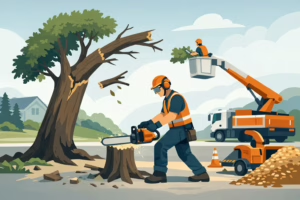
The clearest reason to remove a tree is safety. If a tree is dead, severely damaged, or structurally unsound, removal is often the safest option. A tree that could fall onto a house, fence, driveway, sidewalk, garage, or neighboring property should be evaluated quickly.
Dead trees are especially dangerous because the wood becomes brittle over time. Large limbs can break without much warning, and the entire tree may become unstable. In residential neighborhoods, that is not a risk most homeowners or property managers can afford to ignore.
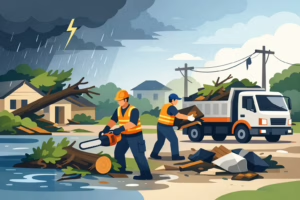
Storm damage is another major trigger. A tree that has split trunks, hanging limbs, exposed roots, or a noticeable lean after a storm may no longer be stable. Sometimes damage looks limited from the ground, but the upper canopy tells a different story. That is why post-storm inspections matter, especially in areas that see strong wind and heavy rain.
Signs a tree may need removal
Some warning signs are obvious. Others are easier to miss until the damage is advanced. If you notice several of these issues at the same time, the likelihood of removal goes up.
The tree is dead or mostly dead
A dead tree usually needs to come down, particularly if it is near structures or areas people use regularly. Signs include major bark loss, no leaf growth during the growing season, brittle branches, and extensive dieback throughout the canopy. A tree with only a few living limbs left is often beyond practical recovery.
The trunk has major cracks or cavities
Cracks in the trunk or large hollow sections can point to serious structural weakness. Not every cavity means immediate removal, but deep decay in the main trunk affects the tree’s ability to support its own weight. If that weakness is combined with heavy limbs or a poor lean, the risk increases quickly.
The tree is leaning more than it used to
A slight natural lean is not always a problem. A recent lean, a worsening lean, or soil heaving around the base is more concerning. That can mean root failure, and root failure is one of the biggest predictors of sudden tree collapse.
Large limbs are failing repeatedly
If major branches keep breaking, the tree may have deeper structural issues. Repeated limb loss can be tied to decay, weak branch unions, excessive end weight, or disease. In some cases, corrective pruning or cabling can help. In others, the tree has become too compromised to retain safely.
Roots are damaged or destabilized
Tree roots are easy to underestimate because most of the problem stays underground. Construction, trenching, soil compaction, erosion, and grade changes can all damage root systems. When enough structural roots are lost, the tree may still look healthy for a while even though its stability has been reduced.
Disease, decay, and when removal makes sense
Not every diseased tree needs removal. Some can be treated or managed. But once disease or decay has spread far enough, removal may be the most responsible choice.
Fungal growth at the base, soft or crumbling wood, dead sections in the canopy, and mushrooms around the root flare can all point to internal decay. The challenge is that decay is often more extensive inside the tree than it appears from the outside. A tree may still leaf out and look green while critical structural wood is failing.
There is also a practical side to the decision. If treatment is unlikely to restore health, or if the cost of repeated intervention does not make sense for the tree’s condition, removal may be the better long-term investment. This is especially true when the tree is close to a home, parking area, or shared property line.
When a healthy tree still needs to be removed
Sometimes a tree is not dead or diseased, but it is still the wrong tree for the location. This happens more often than many people realize.
A healthy tree may need removal if it is growing too close to the foundation, interfering with utility lines, lifting sidewalks, crowding other valuable trees, or blocking planned construction. In those cases, the issue is not whether the tree is alive. It is whether the tree can remain there without creating expensive or recurring problems.
Species choice also matters. Some trees outgrow small yards. Others are more prone to weak branching, aggressive roots, or storm failure. If a tree has become a constant maintenance issue and the risk keeps increasing with age, removal can be a reasonable property management decision.
When pruning or support may be enough
Tree removal is not always the first answer. A professional inspection may show that the tree can be retained with proper care. Selective pruning can reduce weight on overextended limbs, remove deadwood, and improve clearance from structures. Cabling and bracing may help support certain trees with weak unions or multiple stems.
That said, support systems are not a cure-all. They work best in specific situations and require an experienced assessment. If the trunk is extensively decayed, the root system is failing, or the tree is already in severe decline, support may only delay a necessary removal.
For homeowners, this is where expert guidance matters most. Removing a tree too early is frustrating. Removing it too late can be dangerous and expensive.
When to remove a tree after a storm
After a storm, timing matters. If a tree is touching power lines, has a split trunk, is partially uprooted, or has large suspended limbs, it should be treated as an immediate hazard. Keep people away from the area and call a qualified tree service as soon as possible.
Less obvious storm damage still deserves attention. A tree may remain standing but have fractured limbs, hidden cracks, or root movement that weakens it over the next few weeks. Delayed failure is common after severe weather, which is why a prompt inspection is the safer move.
In the Vancouver, Washington area, wet soil and wind can create the kind of conditions that expose existing weaknesses fast. Trees that were already stressed often fail first.
Why professional evaluation matters
Tree risk decisions are rarely about one symptom alone. A lean might be manageable on one tree and urgent on another. Decay might be contained in one case and catastrophic in the next. The difference comes down to structure, species, target area, and how likely failure is.
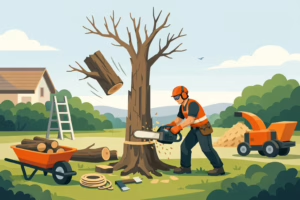
Professional tree crews evaluate more than surface appearance. They look at canopy condition, trunk integrity, root zone issues, site conditions, and nearby targets such as homes, driveways, and neighboring structures. They also know when removal can be performed safely and when specialized rigging, controlled dismantling, or emergency response is needed.
That is particularly important with large trees or trees near buildings. This is not a situation for guesswork. Safe tree work depends on trained crews, proper equipment, and work practices that follow ANSI standards and OSHA regulations.
Making the call before it becomes urgent
A lot of removals happen later than they should because the tree has looked questionable for years without actually failing. That can create a false sense of security. Trees do not always decline in a straight line. Sometimes they hold on for a long time, then fail all at once.
If you are seeing dead limbs, trunk damage, root issues, storm-related changes, or a tree that no longer fits the space safely, it is time to have it assessed. M & R Tree Services helps homeowners and property managers make informed decisions with safety, reliability, and professional care at the center of every job.
The best time to act is before a questionable tree becomes an emergency.