
When a crew shows up to remove a leaning tree near your roof, safety stops being a buzzword and becomes the whole job. Hiring an OSHA compliant tree service matters because tree work is high-risk by nature. It involves chainsaws, rigging, heavy limbs, power lines, elevated work, and unpredictable tree movement. The difference between a professional operation and a careless one often shows up in the safety standards they follow before the first cut is made.
For homeowners and property managers, that matters for more than peace of mind. It affects job quality, property protection, liability exposure, and whether the work is handled by a team that respects both the site and the people on it. If you are hiring tree removal, pruning, storm cleanup, or structural support work, understanding what OSHA compliance means can help you make a better decision.
What is an OSHA compliant tree service?
An OSHA compliant tree service is a company that performs tree work in a way that aligns with Occupational Safety and Health Administration requirements for worker safety. In practical terms, that means the crew follows established procedures for hazard recognition, equipment use, personal protective equipment, safe cutting practices, and jobsite control.
That does not mean every company will describe its process the same way, and it does not mean OSHA is the only standard that matters. In tree care, ANSI standards also play an important role, especially around arboricultural practices and safety procedures specific to the industry. A professional company should understand both. OSHA addresses workplace safety requirements. ANSI helps define accepted industry practices. Together, they set a clear baseline for how serious tree work should be done.
For a customer, the takeaway is simple. An OSHA compliant tree service is not guessing its way through dangerous work. It is operating with rules, training, and accountability.
Why OSHA compliance matters on residential properties
Many people assume safety rules matter most on large commercial jobsites. In tree care, residential properties can be just as dangerous, and sometimes more complicated. Tight access, fences, sheds, vehicles, landscaping, neighboring homes, and overhead utilities all make the work more technical.
A qualified crew should not treat a backyard removal like a quick cut-and-drop job just because it is on private property. The same hazards still exist. Falling limbs can damage structures. Improper rigging can send heavy wood into a fence or window. Poor communication on the ground can put workers and bystanders at risk.
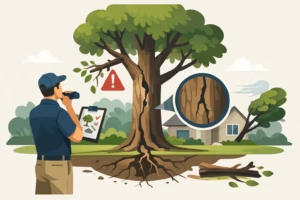
When a company takes OSHA compliance seriously, that usually shows up in the planning. The crew evaluates the tree, the drop zone, nearby targets, electrical hazards, escape paths, and the condition of the tree itself. Dead, storm-damaged, split, or structurally weak trees need a different approach than healthy trees in open space. Good safety practices help crews adjust to those conditions instead of forcing a one-size-fits-all method.
What customers should expect from an OSHA compliant tree service
Most property owners are not expected to know every regulation. You should, however, be able to recognize the signs of a professional operation.
First, the crew should arrive prepared. That includes appropriate safety gear, maintained equipment, and a clear plan for the work area. Hard hats, eye and face protection, hearing protection, chainsaw protective equipment, and proper climbing or aerial lift gear are not extras. They are part of doing the job responsibly.
Second, the site should be controlled. A professional team does not allow people to wander under active cutting zones. It sets boundaries, communicates clearly, and keeps the work area organized. That protects workers, homeowners, neighbors, and anyone else nearby.
Third, the company should be able to explain its process in plain language. You should be able to ask how they will access the tree, how they will protect the property, whether rigging is needed, and how debris will be handled. If answers are vague or dismissive, that is worth paying attention to.
Finally, a safety-minded company will not promise the fastest possible job at any cost. Sometimes the safest way takes more time, more equipment, or a larger crew. That can affect price. It is one reason the cheapest quote is not always the best value.
OSHA compliant tree service and liability
Homeowners often focus on the visible result – the tree is gone, the limbs are trimmed, the stump is ground. The less visible issue is liability. If a company cuts corners on safety, that can create problems beyond poor workmanship.
If a worker is injured on your property, or if unsafe practices lead to damage, the situation can become expensive and stressful quickly. That is one reason professionalism matters so much in tree care. A properly run company is more likely to have the right insurance, trained personnel, and established safety procedures.
Compliance is not a magic shield, and no honest company should suggest that accidents are impossible. Tree work carries real risk even when done correctly. But there is a major difference between managed risk and careless risk. A company that follows OSHA requirements is showing that safety is built into its operations rather than treated as an afterthought.
Safety standards affect quality, not just protection
There is a common assumption that safety only slows things down. In reality, safety and quality usually go together in professional tree work.
A crew that plans cuts carefully is also more likely to control where wood lands. A crew that uses proper rigging is also more likely to protect roofs, driveways, and landscape features. A crew that understands positioning, load forces, and tree structure is not only safer. It is usually more precise.
The same applies to pruning. Good pruning is not just about removing branches. It requires judgment about tree health, branch unions, weight distribution, and long-term structure. Standards-based work helps avoid topping, over-pruning, or unnecessary damage that can leave a tree weaker than before.
That is why many property owners looking for an OSHA compliant tree service are really looking for something broader – a company that combines safety, technical skill, and respect for the property.
Questions to ask before hiring
If you are comparing tree companies, a few direct questions can tell you a lot. Ask whether the company follows OSHA regulations and ANSI standards. Ask whether the crew is trained for the specific type of work you need, especially if the job involves storm damage, large removals, climbing, cabling, or trees near structures.
You can also ask how the company plans to protect your property and manage the jobsite. A reliable answer should sound clear and practical, not rehearsed. If the company cannot explain how it will perform the work safely, that is a concern.
It is also reasonable to ask about insurance and whether the company has experience with similar jobs. A small ornamental pruning job is very different from dismantling a hazardous tree over a home. Experience matters, and so does honesty about the complexity of the work.
When safety matters even more than usual
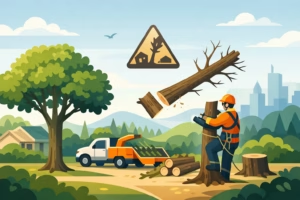
Some jobs raise the stakes. Storm-damaged trees are a good example. A tree that is split, partially uprooted, or hung up in another tree can behave unpredictably. Tension and compression in the wood can create sudden movement when cuts are made. Those are not jobs for rushed decision-making.
Emergency response also creates pressure. Customers want the hazard removed fast, which is understandable. But urgency should not erase process. The right company responds quickly while still evaluating the safest way to proceed.
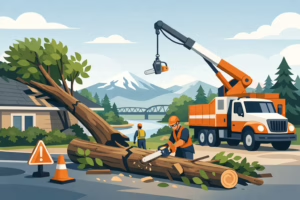
The same goes for trees close to homes, fences, garages, and utility lines. These situations often require sectional dismantling, rigging, or other controlled methods. Safety compliance is especially important when there is little margin for error.
For property owners in the Vancouver, Washington area, working with a local company that understands these conditions can make a real difference. M & R Tree Services emphasizes OSHA regulations and ANSI standards because those details matter when the work is dangerous, technical, and close to what matters most to you.
Choosing confidence over guesswork
You do not need to become a safety expert to hire the right tree company. You just need to know what professionalism looks like. An OSHA compliant tree service should communicate clearly, plan carefully, use proper equipment, and treat safety as part of the job rather than a sales phrase.
That approach may not always produce the lowest estimate or the fastest promise. What it does offer is something more valuable – confidence that the work will be handled by people who understand the risk, respect the property, and take the responsibility seriously.
When a tree needs real attention, the best choice is usually the company that makes safety visible from the first conversation onward.