
That cracked limb over the driveway might look manageable from the ground. It often is not. A good homeowner guide to safe tree care starts with one clear principle: most tree injuries and property damage happen when people underestimate weight, height, tension, or decay.
For homeowners in Vancouver, Washington and nearby communities, tree care is not just about appearance. It is about protecting your home, your vehicles, your fence line, your power service, and the people who walk under those branches every day. Trees add value and shade, but when maintenance is delayed or handled the wrong way, they can become a serious liability.
This guide is built for property owners who want to make smart decisions, reduce risk, and know when a job belongs in professional hands.
A homeowner guide to safe tree care starts with risk, not aesthetics
Many people first notice a tree because it looks overgrown. The more urgent question is whether it is structurally sound. A tree can still look green and full while hiding decay, root damage, or weak branch unions.
Start by looking at what the tree could hit if it fails. A branch over a roof, a leaning trunk near a driveway, or limbs extending over utility lines deserve more attention than a tree in an open back corner of the yard. The target matters. So does the season, recent weather, and the species of tree.
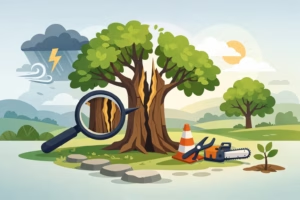
Next, look for visible warning signs. Dead limbs, hollow sections, split trunks, mushrooms at the base, lifted soil around roots, sudden lean, and bark separation can all point to structural problems. Not every crack means immediate failure, and not every leaning tree is unsafe. But those signs should move the tree from the “get to it later” category into the “have it assessed” category.
The key trade-off is simple. Waiting may save money in the short term, but delayed care often turns a manageable pruning job into an emergency removal.
What homeowners can do safely
Safe tree care does not mean doing all the work yourself. It means knowing which tasks are reasonable at ground level and which ones carry unacceptable risk.
For most property owners, the safe zone includes basic observation, watering during prolonged dry periods, mulching properly around the root zone, and reporting changes early. You can also remove very small debris or fallen twigs from the yard after a storm once the area is stable.
Mulch is helpful when used correctly. Keep it a few inches away from the trunk and spread it over the root area rather than piling it like a volcano. Deep mulch against the bark holds moisture where it should not and can contribute to decline.
Watering matters more than many people realize, especially during hot, dry stretches. Deep, occasional watering is usually better than frequent shallow watering. The goal is root support, not constant saturation.
You can also document concerns. Take photos of cracks, leaning, canopy dieback, or storm damage. That helps track whether a condition is stable or getting worse, and it gives a tree professional a useful starting point.
What should stay off-limits
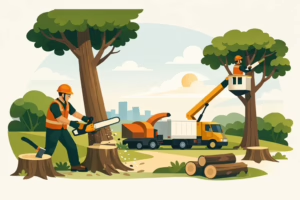
Ladders, chainsaws, ropes, and overhead limbs are a dangerous combination. Add decay, wet bark, or storm damage and the risk goes up fast. If a branch is large enough to cause injury, overhangs a structure, or requires you to leave the ground, it is usually not a homeowner job.
Work near power lines should never be attempted by an untrained property owner. Even branches that are not touching a line can shift unexpectedly while being cut. Conductivity, hidden tension, and poor access make these situations especially hazardous.
The same goes for partially fallen trees, hung-up limbs, split leaders, and root-compromised trees after storms. These failures store force in ways that are hard to read from the ground. What looks stuck can spring, roll, drop, or twist without warning.
A homeowner guide to safe tree care has to be honest here: pruning and removal are skilled trades when height, rigging, weight distribution, and structural defects are involved.
Pruning: where good intentions go wrong
Homeowners often call for pruning when a tree blocks light, brushes the house, or drops limbs. Those are valid reasons. The problem is that improper pruning can weaken the tree, encourage poor regrowth, or make future failures more likely.
Topping is one of the most common mistakes. Cutting the main crown back to stubs may seem like a quick fix for height, but it stresses the tree and usually triggers fast, weakly attached shoots. That means a short-term reduction can create a bigger long-term hazard.
Over-thinning is another issue. Removing too much interior canopy can leave a tree exposed to sunscald, reduce energy production, and change how wind moves through the crown. More cutting is not always safer cutting.
Proper pruning depends on timing, species, branch size, and the tree’s overall condition. A younger tree may benefit from structural pruning to improve form. A mature tree near a home may need selective reduction or deadwood removal. A declining tree may be a removal candidate rather than a pruning candidate. It depends on the tree and the objective.
Storm season changes the equation
After wind, snow, or ice, even healthy trees can fail. If a tree has dropped limbs or shifted position, keep people away from the area first. Do not park under it, do not start cutting to “finish the job,” and do not assume the danger is over because the weather has passed.
Storm-damaged trees often have hidden fractures. Branches can hang by a strip of wood. Trunks can split without fully separating. Root systems can loosen underground before the lean becomes obvious. These are the moments when quick decisions matter most.
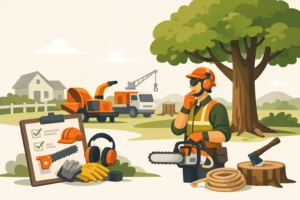
Emergency response should focus on stabilization and hazard removal, not cosmetic cleanup. Clearing a driveway is helpful, but not if it puts someone under a compromised canopy. This is why trained crews use controlled methods, proper equipment, and work practices built around safety standards.
How to choose a tree company safely
Not all tree work is equal, and not all crews operate with the same level of professionalism. When a tree is close to your home or presents a hazard, the company you hire matters.
Look for a business that is licensed and insured, has solid local experience, and can explain how the work will be done. Ask whether they follow ANSI standards and OSHA regulations. Those are not marketing buzzwords. They reflect whether the company treats safety as a system rather than an afterthought.
It is also worth paying attention to how they communicate. A dependable company should be clear about the scope of work, realistic about what can be safely saved, and honest when removal is the better option. Fast response matters, especially after a storm, but rushed answers and vague promises are not the same thing as professional service.
Affordable service has value. So does getting the job done correctly the first time. The lowest bid is not always the lowest cost if poor cuts, property damage, or incomplete cleanup create new problems.
Tree removal, support systems, and stump work
Sometimes the safest tree is the one that comes down. Dead trees, severely decayed trunks, major root loss, or trees with significant structural defects near homes may no longer be good candidates for preservation. Removal is not a failure. In many cases, it is the most responsible safety decision.
In other cases, support systems like cabling or bracing may help manage risk in a tree with weak branch unions or structural stress. These systems are not universal fixes, and they need proper evaluation and installation. Used in the right situation, they can extend the life of a tree while reducing the chance of failure.
Stumps deserve attention too. They are easy to ignore, but they create mowing hazards, attract pests in some conditions, and make replanting or landscape work harder. Grinding or removal can finish the job cleanly and reduce long-term nuisance issues.
When it is time to make the call
If you see cracking, sudden leaning, dead upper canopy, branches over your roof, storm damage, or tree growth near service lines, it is time for a professional assessment. The same is true if you are simply unsure. Uncertainty is reason enough when the consequences of guessing wrong are high.
For homeowners who want safe, reliable help, the best next step is to bring in a trained crew that understands residential tree work, follows recognized safety practices, and respects your property. Companies like M & R Tree Services are built for exactly that kind of work – practical solutions, clear communication, and dependable service when safety is on the line.
The right tree care decision usually starts before there is an emergency, and that is what protects both your landscape and your peace of mind.