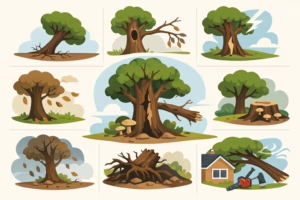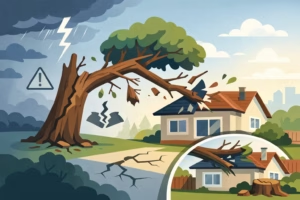

A large limb hanging over a driveway or roof gets your attention fast, especially after wind, heavy rain, or a close call during a storm. In many cases, cabling weak tree limbs can reduce the risk of failure and help preserve a valuable tree that might otherwise need aggressive pruning or removal.
For homeowners and property managers, the key question is not just whether a limb looks weak. It is whether the tree can be supported safely and whether that support will actually improve the tree’s long-term stability. Cabling is not a cosmetic fix. It is a structural support system that should be installed only when the tree, the defect, and the surrounding target area all justify the work.
What cabling weak tree limbs actually does
Tree cabling is designed to limit the movement of limbs or stems that are more likely to split, crack, or fail under stress. The system typically uses high-strength cables installed in the upper canopy to reduce the load on weak branch unions, co-dominant stems, or limbs with included bark and other structural defects.
The goal is not to make a defective tree perfect. The goal is to lower the chance of a major failure while preserving as much of the tree as practical. That distinction matters. Some trees can benefit from support and careful pruning. Others are too compromised and should be removed for safety.
A proper recommendation depends on species, size, condition, defect severity, and what the tree could hit if it fails. A limb over open yard space presents one level of risk. A similar limb over a home, parked cars, play area, sidewalk, or neighboring property is a different situation.
When cabling weak tree limbs is a good option
Cabling is often considered when a tree has significant value and the weakness is localized rather than widespread. Mature shade trees, ornamental trees with important landscape value, and trees that provide screening or cooling are common candidates if they are otherwise healthy.
One of the most common situations is a tree with co-dominant stems. That means two main stems are growing from the same point, often with a narrow attachment. Over time, those unions can become weak, especially when bark gets trapped between them. As the stems gain weight, the risk of splitting increases.
Another example is a long, heavy lateral limb with a visible crack, excessive end weight, or poor attachment angle. If the rest of the tree is in good condition, support cabling combined with weight reduction pruning may help retain that limb more safely.
Storm history also matters. Trees in Vancouver and nearby areas can be exposed to wind, saturated soil, and winter weather that put added stress on already weak attachments. A limb that has shifted, sagged, or shown early signs of failure after a storm should be evaluated promptly.
When cabling is not the right answer
Not every weak limb should be cabled. If a tree has advanced decay, root failure, major trunk defects, or multiple structural problems throughout the canopy, support hardware may only delay a larger issue. In those cases, cabling can create a false sense of security if the underlying condition is no longer manageable.
It also may not be the best choice if the limb is already too damaged or if the defect is in a part of the tree that cannot be meaningfully stabilized. Sometimes selective pruning is enough. Other times, removal is the safer and more cost-effective path.
This is where professional assessment matters. A support system should be based on the actual condition of the tree, not just on the owner’s understandable desire to save it.
How a professional evaluates a tree for cabling
A qualified tree care team starts with the structure of the tree itself. That includes the branch union, stem configuration, canopy balance, defect location, and signs of decay or cracking. The team should also consider the species and growth pattern, since some trees are more prone to weak attachments than others.
The next step is looking at targets. A tree that could strike a structure, utility-adjacent area, access route, or occupied outdoor space carries higher consequences if it fails. Risk is not only about the tree. It is also about what surrounds it.
A good evaluation also includes maintenance planning. Cabling is not a one-time set-it-and-forget-it service. Support systems need inspection over time, and trees often benefit from follow-up pruning to reduce stress on supported limbs.
Cabling and bracing are not the same thing
Homeowners often hear the terms together, and for good reason. They are related but not interchangeable.
Cabling is generally installed higher in the canopy to limit excessive movement between stems or limbs. Bracing usually involves threaded rods installed through a weak union or split area to provide more direct reinforcement. In some cases, a tree needs both.
The right setup depends on the defect. If there is active splitting at a union, a brace may be part of the recommendation. If the concern is excessive movement and future failure, cabling may be enough. The best plan is based on the tree’s condition, not a one-size-fits-all service.
Why standards and proper installation matter
Structural support work should be performed to recognized industry standards. That is not just a technical detail. It directly affects safety, performance, and the future condition of the tree.
Improper hardware placement can create additional wounds, concentrate stress in the wrong area, or fail to provide meaningful support. Over-tightened systems can also interfere with natural movement in ways that are not beneficial for the tree. On the other hand, a properly selected and installed system works with the tree’s structure instead of against it.
That is why experienced crews follow ANSI standards and maintain OSHA-compliant work practices. Support installation happens aloft, often around large limbs and defect zones where safety cannot be treated casually. Professional tree work is not just about getting hardware into the canopy. It is about doing the work correctly and safely from start to finish.
What homeowners can expect after installation
Cabling does not make a tree maintenance-free. The tree should still be inspected periodically, especially after major wind events or storms. Hardware, attachment points, and supported limbs all need to be checked as the tree grows.
In many cases, pruning is part of the long-term plan. Reducing excess weight on an overextended limb can improve the effectiveness of the cable system. This combination often provides better results than cabling alone.
Homeowners should also understand that support systems reduce risk, not eliminate it. Any tree with a structural defect deserves ongoing attention. The benefit is that, when the tree is a good candidate, cabling can extend retention and improve safety without removing a valuable part of the landscape.
The value of early action
The best time to evaluate a weak limb is before it fails. Once a major split occurs, options become more limited and the urgency becomes higher. Waiting can turn a manageable support job into emergency tree service, property damage, or complete removal.
If you have a tree with a heavy overextended limb, a questionable fork, or visible cracking near a branch union, it is worth having it assessed by a professional. A timely recommendation may confirm that the tree can be supported, pruned, or monitored before the problem becomes more serious.
For local homeowners who want practical answers, M & R Tree Services provides professional tree assessments and structural support solutions with safety and quality in mind. If a tree can be preserved responsibly, cabling may be the right step. If it cannot, you should know that before the next storm tests it.
A strong tree does not always need to come down when one limb becomes a concern. Sometimes the right support, installed the right way, is enough to protect both the tree and the property around it.